
Pattern creation
Garment pattern making from Morocco
In short
I create garment patterns from your sketch, tech pack, measurement chart or reference sample, and deliver them ready for sampling and production. Each pattern includes seam allowances, notches, grainlines and piece labels, and is built so it can be graded and cut without rework. I work remotely for brands in Morocco, France, Belgium, Switzerland and further afield.
By Youssef Abdessamad·Updated on
Pricing
On quote
Free quote, prepared after reviewing your design
- Turnaround
- Depends on complexity, confirmed in the quote
- Delivery
- Digital files, printing on request
- Software
- Lectra, Gerber AccuMark, CLO 3D
A pattern is the technical translation of a design: it decides how much ease the garment has, how the fabric hangs, how pieces join at the machine and how much fabric the marker will consume. When a sample fits badly or a factory keeps asking questions, the cause is usually in the pattern, not in the sewing.
I build each pattern from a base size you define, using your measurement chart or a size standard we agree on. I check seam lengths against each other, walk notches from piece to piece and set grainlines according to the fabric, so the first sample is a real test of the design rather than a test of the pattern.
Patterns can be delivered as digital files, printed at full scale or both. If you already have a pattern that needs adjusting, see pattern correction; if you need the full journey from sketch to approved sample, see garment development.
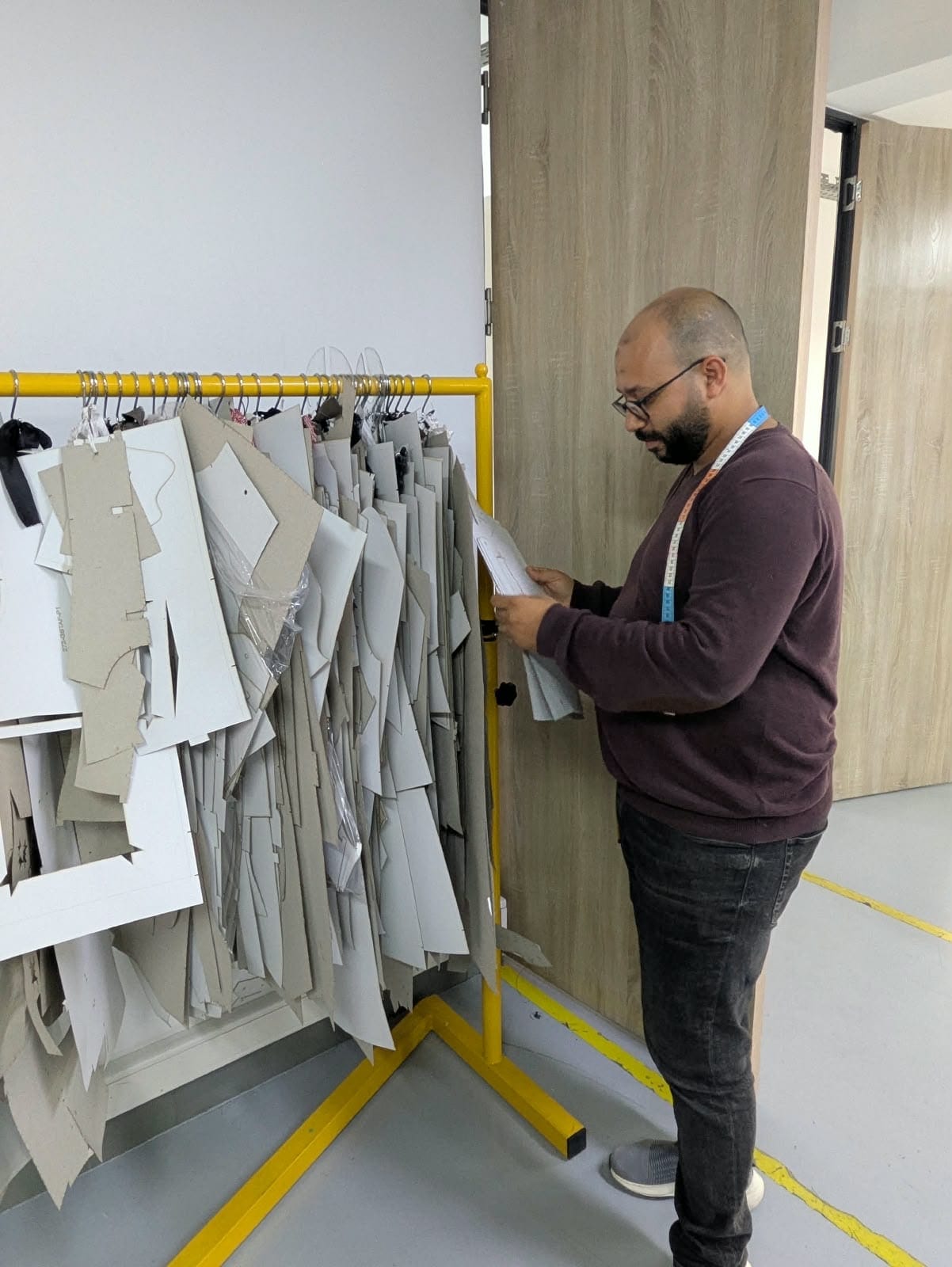
What’s included
Brief and measurement review
I read your sketch, tech pack or reference garment and confirm the base size, key measurements, tolerances and fabric before drafting.
Pattern drafting
All pattern pieces are drafted: main body, facings, linings, interfacings and pockets where required, with darts, pleats and style lines placed to match the design.
Construction marks
Seam allowances, notches, drill holes, grainlines, fold lines and piece labels (name, size, number to cut) are added to every piece.
Seam and fit checks
I walk matching seams, check armhole and sleeve cap lengths, and control neckline and waist curves so pieces join cleanly at the machine.
File preparation
The pattern is exported in the format your workshop or factory uses. Available formats depend on the software used and the project; see file formats.
Post-sample adjustment
After your first sample, I can adjust the pattern based on your fit comments or photos of the sample on a model or form.
Deliverables
- Complete pattern in the base size, all pieces included
- Seam allowances, notches, drill holes and grainlines on every piece
- Piece labels: name, size, cut quantity and fabric
- Digital files in the agreed format (for example DXF-AAMA, PDF or PLT)
- Piece list with cut quantities
- Full-scale printed pattern on request
Who it’s for
- Independent fashion designers
- Emerging and established fashion brands
- E-commerce clothing brands
- Garment factories and sewing workshops
- Fashion startups preparing a first collection
- Uniform and workwear manufacturers
How it works
- 1
Brief
You send your sketch, tech pack, reference photos or a sample, plus the target size range and fabric. A checklist is available in how to prepare a brief.
- 2
Quote and questions
I confirm what is clear, list what is missing and send a quote with the scope and an estimated turnaround.
- 3
Drafting in the base size
I draft the pattern in the base size and add all construction marks and piece information.
- 4
Checks and export
I run seam, notch and grainline checks, then export the files in the agreed format, with PDF documentation if needed.
- 5
Sample feedback
Once your sample is sewn, you send fit comments and photos, and I adjust the pattern before grading.
How pattern decisions show up in the finished garment
Ease is the difference between body measurement and garment measurement, and it is a design decision, not a fixed rule. A fitted woven shirt and an oversized one can share the same chest measurement on the size chart but carry very different ease, and that ease changes how the armhole must be shaped. In knits, ease is often negative: the pattern is smaller than the body, and the reduction depends on the fabric’s stretch percentage.
The sleeve cap is a good example of how precise a pattern must be. The cap is usually slightly longer than the armhole, and that extra length, the cap ease, is eased in during sewing so the sleeve hangs without pulling. If a notch on the cap is shifted by even a few millimeters, the ease ends up in the wrong place, and the sleeve twists forward or backward. That is a pattern fault, not a sewing fault.
Fabric behavior also has to be built in. Denim and some linens shrink after washing; if shrinkage is not added to the pattern, a trouser that measures correctly off the machine will be too short after the first wash. For production, I ask for a shrinkage test result when the fabric is known to move.
- Seam allowance
- The width added outside the stitching line. It varies by seam type and machine (for example narrower on overlocked knit seams, wider on seams that will be pressed open or altered later).
- Notches
- Small marks that align pieces during sewing. They control where ease is distributed and prevent pieces from being joined off-balance.
- Grainline
- The arrow that tells the cutter how to place the piece relative to the fabric’s warp. A piece cut off-grain can twist or hang unevenly.
- Base size
- The size the pattern is drafted and sampled in. All other sizes are derived from it through grading, so it should be a size you can fit on a real person or form.
Common mistakes before ordering a pattern
Sending a sketch without a measurement chart or a reference garment, which leaves the proportions to guesswork.
Changing the fabric after the pattern is done: a pattern drafted for a stable woven will not fit the same in a stretch fabric.
Grading before the base-size sample has been fitted and approved, which multiplies any fit error across every size.
Not stating the target production method (small workshop or factory with automated cutting), which affects file format and marking conventions.
Delivery formats
- DXF-AAMAPattern exchange between textile CAD systems (Lectra, CLO 3D, Gerber, Optitex…).
- DXF-ASTMStandardized variant (ASTM D6673) used by some manufacturers and software.
- Full-scale PDFPrinting on a wide-format plotter or on tiled sheets, and technical documentation.
- PLT / HPGLDirect output to a workshop plotter.
Available formats depend on the software used and the project requirements.
Pricing
Pricing
On quote
Free quote, prepared after reviewing your design
Every pattern is priced on a free quote: the price depends on the design’s complexity, the number of pattern pieces and whether grading or printing is included. Send me your project on WhatsApp to get it. See pricing.
Frequently asked questions
What do you need to start a pattern?
Can you make a pattern from an existing garment?
Do you work with clients outside Morocco?
Is the pattern ready for production after the first sample?
Which file format will I receive?
Related services
- Garment developmentTechnical development of your designs, from sketch or reference garment to a validated sample and production pattern.
- Pattern gradingEvery size in your range, graded from your approved base pattern with rules built on your size chart.
- Digital pattern makingGarment patterns drafted directly in CAD, ready to grade, plot and share with any factory.
Further reading
What is pattern making in fashion?
Pattern making is the step where a sketch becomes a set of precise, sewable pieces. Here is how it works in practice and why most fit problems start there.
Read articleHow to prepare a brief for a pattern maker
A clear brief is the cheapest way to reduce sample rounds. This is the checklist I wish every client used before sending a project.
Read article
Tell me about your project.
Send your references and technical requirements. Every project is assessed according to its level of complexity.